
Solution 1: Beyond the NIMBY trap: How one city turned waste into a community asset
Applicant: Grandblue Environment Co., Ltd.
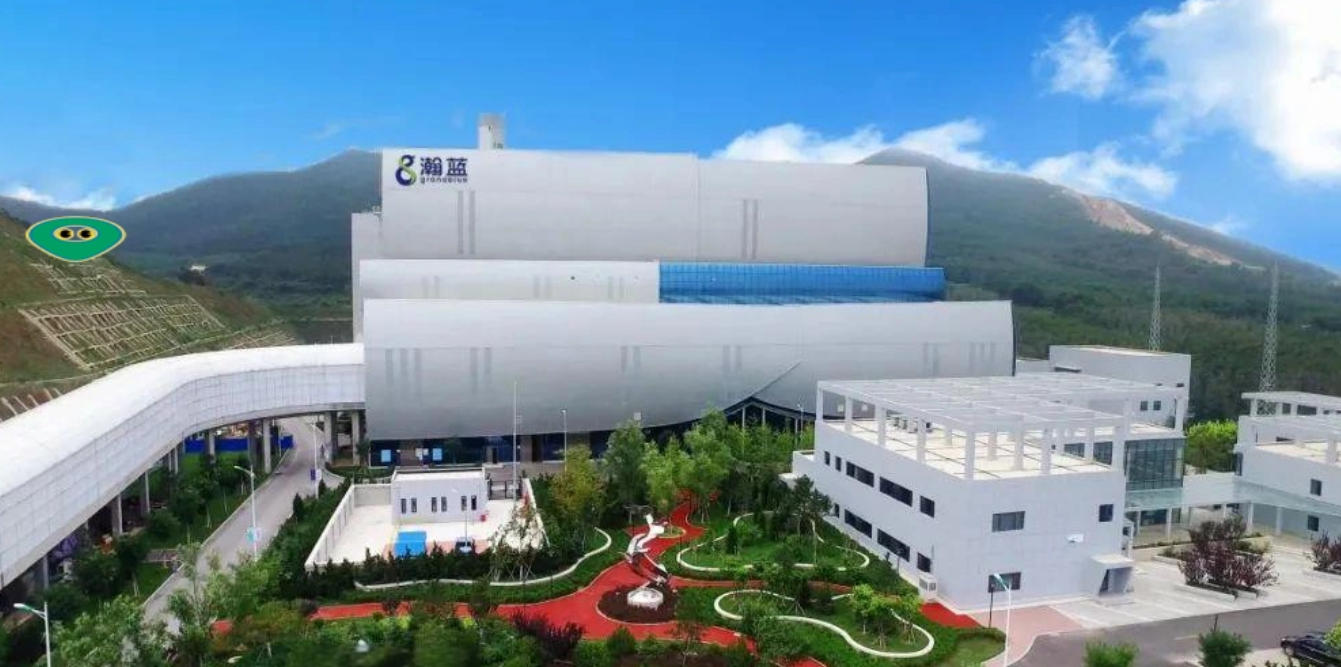
Abstract: Grandblue pioneered a centralized solid waste treatment environmental industrial park designed to minimize overall social costs. Adhering to high-quality construction and operation, transparency, open communication, consistency, and a commitment to responsibility, the company works with local communities and shares environmental assets with the media. Over the past decade, this approach has resulted in zero effective complaints and zero petitions from surrounding residents, creating a “wall-free” harmonious coexistence model recognized by media outlets such as People’s Daily.
Challenge
Every city produces waste. But building the infrastructure to process it? That's where things get complicated. Urban solid waste management faces three compounding pressures:
The NIMBY problem. Waste-to-energy (WtE) plants and other treatment facilities are essential — yet communities near proposed sites frequently resist, citing odor, pollution, and health concerns. The result: projects stall, landfills overflow, and cities are left with mounting waste and no place to put it.
Weak environmental oversight. Emissions from treatment facilities are difficult to monitor in real time. Without transparent, credible data, public trust erodes — and regulators struggle to enforce standards.
Low resource recovery. Most facilities handle a single waste stream in isolation, leaving valuable energy and materials on the table. The result is a linear take-make-dispose model that wastes both resources and land.
Solution
Building a Closed-Loop Eco-Industrial Park
Grandblue solved this challenge by designing an integrated eco-industrial park in Nanhai, Foshan. At its core is a waste-to-energy power plant — the energy engine that drives the entire system. Around it, Grandblue co-located:
• Municipal solid waste transfer and treatment
• Sludge processing
• Food waste (kitchen waste) treatment
• Leachate treatment
• Fly ash stabilization
By integrating these streams, the park achieves shared resource use and synergistic treatment — waste heat from incineration powers sludge drying, biogas from food waste supplements fuel, and leachate is recycled within the system. Economies of scale save approximately ¥50 million in annual operating costs through synergies alone.
Smart Operations: The "Industrial Brain"
Grandblue partnered with Alibaba Cloud to deploy an AI-powered optimization system across the park's incinerators. The platform continuously monitors combustion efficiency, emissions, and equipment performance — adjusting parameters in real time to maintain peak output while keeping pollutants below limits. The result is smarter, safer, and more efficient plant operations.
Breaking the NIMBY Trap: Radical Transparency
Grandblue 's approach to community acceptance is systematic and relentless. Three pillars drive it:
"Install, Display, Connect" — real-time environmental data from all emission points is publicly displayed on LED screens at the facility gate. Data is also transmitted directly to environmental regulators, eliminating any gap between what the plant reports and what the public sees.
Third-party oversight — a certified environmental monitoring company maintains a 24/7 on-site presence, independent of Grandblue 's operations team. Their findings are shared directly with local government and community representatives.
Open-door visits — any resident can book a guided tour of the facility. Seeing the technology firsthand, and meeting the people who monitor it, has proven far more persuasive than any public relations campaign.
Zero Pollution Discharge
All wastewater and fly ash produced on-site are treated within the park boundary — nothing is discharged off-site. The system converts potential pollutants into reusable resources: biogas is captured and used for heating, and treated wastewater is reused in the cooling system. Zero pollution leaving the park is both an environmental commitment and a community trust builder.
Impact & Value
Community Trust: A Decade of Zero Complaints
Over more than ten years of operation, the Grandblue Eco-Industrial Park has achieved a remarkable record: zero valid complaints and zero petitions from nearby residents. The park has also eliminated odor emissions and wastewater discharge entirely. Most strikingly, it has built a "no-fence" relationship with neighboring enterprises — including the Guangdong Light Industry Group — sharing infrastructure and living side by side as an integrated community. This is the "Grandblue Model" — a replicable template for cities facing the waste crisis.
Environmental Performance
By 2020, cumulative volumes processed included:
• 11.04 million tonnes of municipal solid waste
• 690,000 tonnes of sludge
• 430,000 tonnes of food waste
• 160,000 tonnes of industrial waste
All emissions have consistently met or exceeded regulatory standards — with several key pollutants performing better than EU Best Available Techniques (BAT) reference levels. The park demonstrates that large-scale waste treatment and environmental excellence can coexist.
Economic Value
The integrated park model creates significant cost advantages: shared infrastructure reduces land use, centralized operations lower regulatory compliance costs, and the synergistic treatment model generates ¥50 million in annual savings. For local governments, it offers a single, accountable operator to oversee — simplifying oversight and reducing the total social cost of waste management.
Solution 2: Paving the way for a zero-carbon future with the NIKE REFURBISHED Program
Applicant: Nike Sports (China) Co., Ltd.
Challenge
In 2020, its China operations saw a full upgrade: Improved disassembly processes have expanded the applications of recycled materials. These were previously limited to rubber for running tracks; foam sole materials are now being repurposed into cones and other sports products. Nike Grind has produced the Space Hippie experimental shoe line, extensively using recycled materials.
Globally, sports shoes contribute 1.4% of annual carbon emissions, yet fewer than 3% are made from biodegradable or recyclable materials. Sports shoe composition is extremely complex — closed-loop recycling faces technical hurdles: difficulty separating diverse materials, performance degradation of sole compounds, and vast variety of upper materials.
Disassembling a complete shoe into recoverable components demands very high technical capability. Climate urgency requires Nike to innovate across every stage — product design, manufacturing, transport, and end-of-life recovery. Beyond advancing technology, establishing circular economy recycling standards and positively influencing the sports consumer market remain Nike’s ongoing mission.
Solution
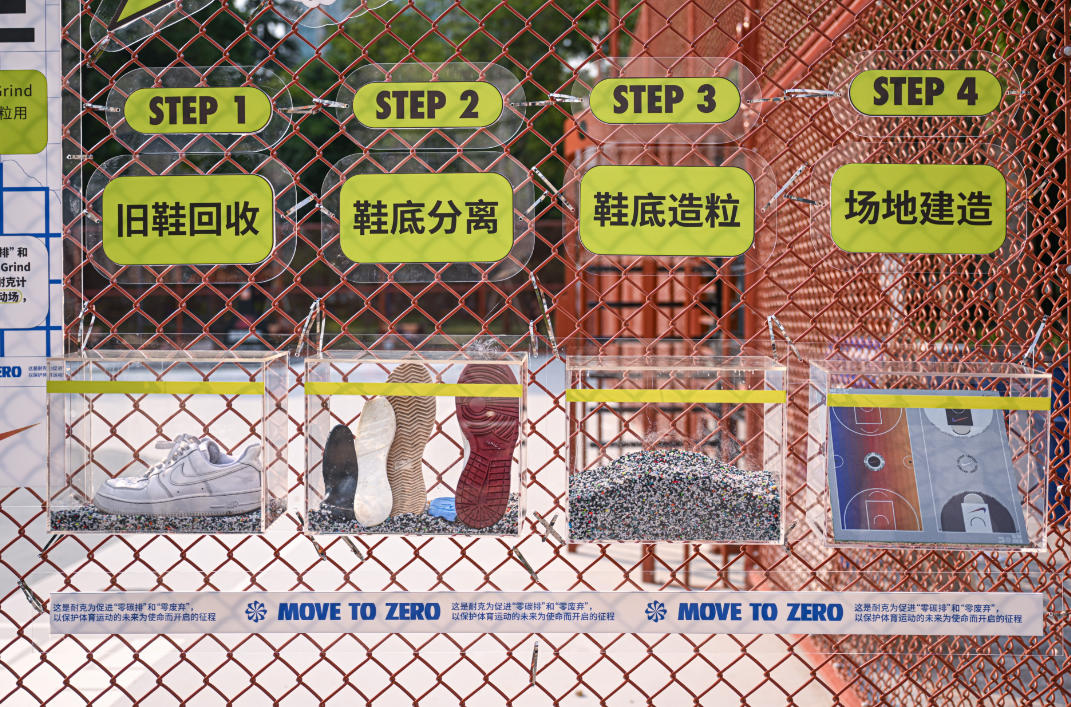
Waste recovery and recycling are central to Nike’s “zero carbon, zero waste” goal. Nike Grind technology, with nearly 30 years in the US, collects manufacturing scrap and unsellable products, processing them through sorting, disassembly, grinding, and remanufacturing into recycled materials。 It was officially introduced to China in 2015.
Since 2015, Nike Grind has built 15 sports fields and activity spaces in China using 141 tons of recycled materials (converted from 910,984 collected old shoes), spanning Beijing, Shanghai, Guangzhou, and remote mountainous areas.
Since 2021, Nike has partnered with Tongji University's Circular Economy Institute on a project to develop closed-loop recycling for used sports shoes, focusing on three areas—multi-component separation, closed-loop processing, and lifecycle carbon measurement and traceability—to be carried out in three phases.
Impact & Value
Ecological value & key breakthrough: Closed-loop recycling spans four process stages: secondary sorting, thermo-chemical-mechanical combined separation, recycled material modification, and recycled product manufacturing. CEC certification confirms a 700g recycled shoe’s carbon footprint at 1.86 kgCO₂e — 3.52 kgCO₂e less than a virgin shoe, a 62.48% reduction. In FY2019, 99.9% of Nike footwear manufacturing waste was reused, with over 105 million pounds of production scrap recycled.
Social value: Since 2015, Nike China has created 154 sports spaces, with a focus on underserved mountainous regions and migrant-worker schools. These facilities help spread circular sustainability practices to younger generations via school and community sports venues.
Economic value: If recycling technology were scaled nationwide for the estimated 330 million sports shoes discarded annually, approximately 40,000 tons of rubber, 90,000 tons of EVA, and 90,000 tons of upper fiber raw materials could be recovered — delivering value across upstream and downstream industries.
Solution 3: Building a circular economy foundation for sustainable healthcare
Applicant: Philips
Challenge
Healthcare systems have long prioritized patient diagnosis and treatment, with energy use and waste management treated as afterthoughts. Yet hospitals generate approximately 13 kg of waste per bed per day, of which 15–25% is hazardous, while the global healthcare sector accounts for over 4% of worldwide carbon emissions. Materials represent the second-largest expense for hospitals after labor, and the extraction of natural resources for manufacturing is a primary driver of biodiversity loss. Confronted by climate change, resource scarcity, and ecosystem degradation, Philips identified circularity as the critical pathway to sustainable resource use, and a prerequisite for decarbonizing healthcare.
Solution
Philips embedded the circular economy into its strategy through the principle of use less, use longer, and use again, built on five pillars: EcoDesign, circular supply chain management, circular delivery and leasing, usage-phase optimization, and end-of-life circular management. Five practical actions underpin this framework: (1) dematerialization and digitalization — deploying digital solutions to reduce hardware consumption and shifting from product sales to performance-based solutions; (2) service and upgrade models — transitioning customers from ownership to access, with maintenance, repair, and software upgrades embedded in agreements; (3) refurbishment — replacing or repairing faulty components to extend product lifespan; (4) recycling — recovering valuable materials from end-of-life components for new production; and (5) sustainable material use — increasing recycled content, improving energy efficiency, and eliminating hazardous substances.
Philips’ EcoDesign system, built around Life Cycle Assessment (LCA), targets four domains: energy efficiency, packaging reduction, material sustainability, and circularity. The EcoHeroes product portfolio showcases breakthrough innovations — notably the BlueSeal helium-free MRI, which employs a 7-liter micro-cooling circuit in place of the conventional 1,500–2,000 liters, eliminating dependency on imported helium, a strategically scarce resource. Trade-in programs with incentive vouchers ensure responsible disposal and reuse of legacy equipment, closing the loop.
Impact&Value
Environmental value: By end-2023, Philips maintained carbon-neutral operations, with 70.5% of new products meeting EcoDesign requirements, 91% operational waste recycling, zero landfill across all plants, and circular products and solutions accounting for 20% of revenue.
Technological leadership: EcoDesign principles have been embedded in product development since the early 1990s, with solutions applicable across clean energy, smart buildings, and transportation.
Social value: Eco-designed products provide affordable health choices for underserved communities — 1.88 billion people have used Philips products and services cumulatively, including 221 million in underserved regions.
Business model innovation: The shift from product sales to service-based models offers a replicable blueprint for energy-intensive manufacturing sectors.
Industry mobilization: Philips engaged suppliers, customers, policymakers, and academic institutions in the circular transition, co-conducting a study on deep decarbonization pathways for China’s healthcare system with Tsinghua University, with several recommendations being adopted by national authorities. The case won the EU Chamber of Commerce in China’s Sustainable Business Award 2023 (Circular Economy) and was shortlisted for the British Chamber of Commerce ESG China Award.