
Solution 1: “Yongyi Charging” model: Paving the way for safe and swift e-bike governance
Applicant: State Grid Ningbo Power Supply Company
Challenge
Over three years, Ningbo recorded 536 e-bike fires—over 80% linked to charging hazards. In 2022, a charging-sparked house fire in Ninghai County claimed seven lives. Three structural problems emerge: infrastructure shortfall — with 400 million e-bikes nationwide, Ningbo faces a gap of over 300,000 charging ports; governance fragmentation — overlapping jurisdictions among urban management, fire services, streets, and property managers create coordination gaps; and service loop failure — public charging costs exceed home rates, and maintenance coverage is thin, producing a “built but unused” vicious cycle.
Solution
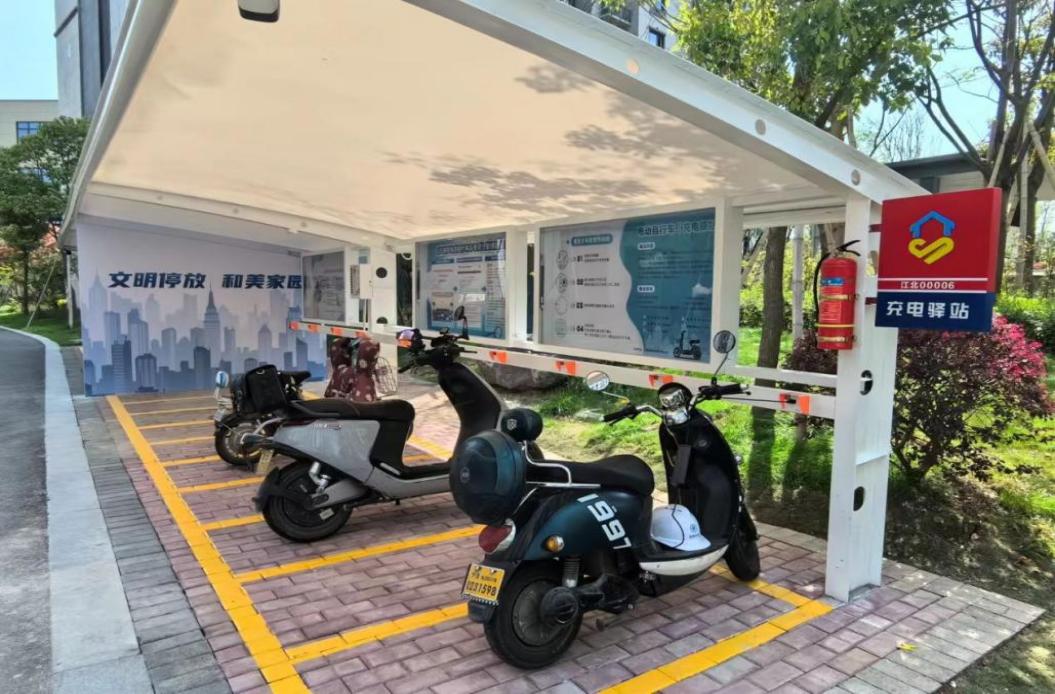
State Grid Ningbo Power Supply Company built the “Yongyi Charging” safe charging model around “government-enterprise-society collaboration, intelligent-driven approaches, and legal safeguards.”
Institutionally, State Grid Ningbo supported Ningbo to pioneer China’s first E-bike Charging Safety Management Regulation (11 core clauses) and a Charging Station Construction Standard. To enable collaboration, the company drove the government to include charging station construction in its 2024–2025 Top 10 Livelihood Projects. By overlaying fire hazard heatmaps, population density GIS layers, and power distribution facility maps, it identifies priority locations for facility development. A “registration-by-declaration” innovation resolved “no-owner” meter installation barriers in older neighborhoods.
To realize digital monitoring, State Grid Ningbo developed China’s first e-bike charging full-sensing monitoring system, which collects real-time electrical parameters, power, and smoke density, identifying overcharge and short-circuit faults. In partnership with fire services, the company launched China’s first city-level Charging Station Management Platform, integrating all operator data for unified governance.
As for service improvement, its residential combined-meter pricing reduces costs and advertising revenue subsidizes infrastructure for sustainable operation. Smart electricity monitors are installed, achieving 90% “current fingerprint” recognition for indoor charging detection. In addition, joint fire-housing-community patrols deter unsafe behavior and cultivate safe habits.
Impact & Value
1. Buildout and early results
Since 2024, 581 Yongyi Charging Stations have been built, bringing the total number of standard charging stations across Ningbo to 11,000, with another 12,000 planned for 2025. E-bike fires dropped to 119 in 2024, a year-on-year decline of 41.95%.
2. Three Breakthroughs
Model breakthrough: A tripartite governance framework among government, enterprises, and communities covering planning, construction, supervision, and service.
Commercial breakthrough: A self-sustaining commercial model that reinvests advertising revenue into station construction.
Digital breakthrough: China's first city-level charging safety platform, enabling proactive defense, automatic response, and early warning.
3. National recognition
The model has attracted field research visits from over 20 provinces and received extensive media coverage, including from CCTV, establishing it as the national "Ningbo Model" for e-bike safety governance.
Applicant: State Grid Suzhou Power Supply Company

By June 2022, China’s NEV stock reached 10.01 million; Suzhou alone had 110,000, projected to hit 390,000 by 2025. Charging demand is surging, yet structural problems persist: older neighborhoods lack charging space, public parking can’t meet demand, and infrastructure remains unevenly distributed with low utilization. The “one charger per car” model yields low utilization (typical users charge only weekly), while fuel-car occupation of EV spots exacerbates scarcity. Charging infrastructure has become the “critical small issue” affecting green mobility.
Solution
Aligning with SDG 9 and SDG 12, State Grid Suzhou developed China’s first all-electric shared EV charging robot system. Rail-mounted on garage ceilings, one shared robot covers 50 parking spaces, intelligently dispatching chargers for “one charger, multiple cars” — achieving a maximum pile-to-space ratio of 1:10.
The system pioneers a “decoupled” mobile charger design, separating movement and charging at the hardware level: the robot handles movement, while modular charging units deliver power, ensuring unobstructed paths. Users scan a QR code and enter their parking number; the robot retrieves an idle charger and delivers it to the target spot — shifting the paradigm from “car finds charger” to “charger finds car.”
Modular prefabricated construction compresses installation from 10 days to 2 (80% faster), reducing capital costs by nearly 20%, with flexible charger scaling. The company also built Suzhou’s NEV and Charging Infrastructure Monitoring Platform, breaking data silos for unified safe operation. Policy-wise, it helped issue guidance on residential charging infrastructure, using time-of-use pricing, reservations, and smart load management to guide orderly charging.
Impact & Value
Economic Value: The 1:10 pile ratio dramatically improves utilization and ROI; modular construction cuts build time 80% and costs approximately 20%.
Social Value: “Charger follows car” delivers convenient charging, reducing social friction from scarce resources. Centralized operation lowers safety risks versus scattered chargers; smart scheduling prevents grid overload from peak-charging clusters.
Environmental Value & Key Breakthrough: The system significantly reduces low-voltage cable usage, conserving copper, aluminum, and zinc, and minimizes repeated construction dust and noise. As China’s first all-electric shared charging robot system, it achieves a breakthrough from “block-segmented” to “area-wide coverage,” earning coverage from People’s Daily and Guangming Daily.